by J.R.R. Tolkien
Discussion prompt by :
Coming soon…
by J.R.R. Tolkien
Discussion prompt by :
Coming soon…
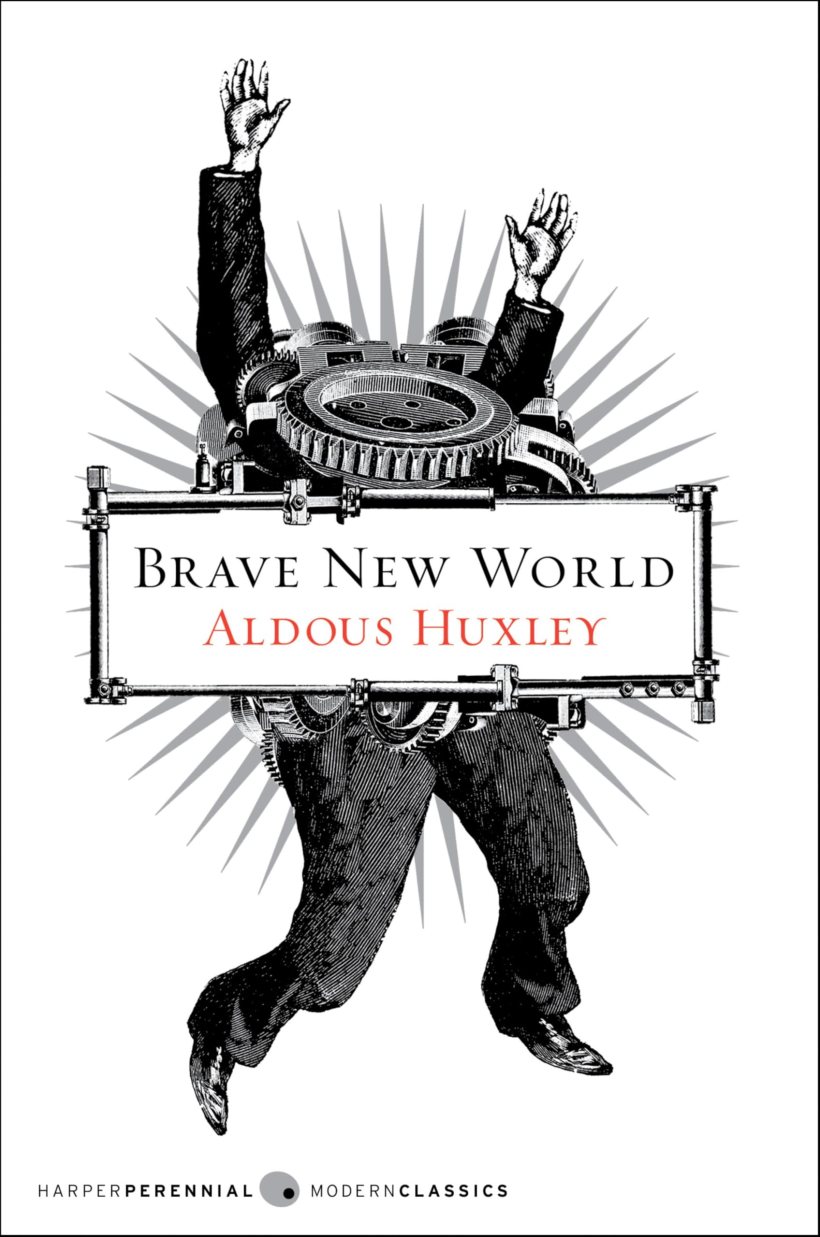
Discussion Prompt by Seth Loh
Community, Identity, Stability.
The irony of the “World State’s” motto is that as you read Huxley’s masterpiece it becomes clear that none of those ideals actually exist. Sure, there’s “community” in the sense that “everyone belongs to everyone else,” so nobody is alone—ever. Your “identity” is found in your class which is hypnopaedically instilled in you through sleep hypnosis so you like being a beta, or a semi moron epsilon. Also, you have no reason to be angsty or passionate which would lead to wars and “instability” because instead of “giving a damn”, you could simply “take a gramme.” But aren’t these just artificial versions of the real ideal?
Brave New World thrives on this type of replacement:real pain is replaced with soma, real pleasure with state-approved entertainment, real family with engineered relationships, and real individuality with uniform consumer identity. These surrogates reflect a fatal problem — Honestly, one where there may be too much to write about. So… in sticking with a major theme of the book – a place where everything is artificially created – I thought I’d let ChatGPT take inspiration from my past write-ups (plus some other prompting and editing, like forcing it to add a CS Lewis quote *cheers*) and do this write-up for me….(sorry Tony). Here it goes…
In stepping into Brave New World by Aldous Huxley, readers are greeted not by a bleak dystopia of war and oppression, but by something far more unsettling—a world where suffering has been eliminated, desire satisfied instantly, and discomfort expertly avoided. It is a civilization engineered for stability, where every citizen has a role, every appetite a remedy, and every emotion a pharmaceutical solution. Yet beneath the shine of order and efficiency lies a haunting question: if nothing is ever truly risked, can anything ever truly matter? In Huxley’s world, the price of peace is the soul.
Central to this artificial paradise is soma—a wonder drug that keeps society running smoothly. It dulls anxiety, erases grief, and removes any reason to question. It is escape without cost, comfort without confrontation. But the more the citizens swallow soma to silence their discontent, the clearer it becomes that they’ve forfeited the very things that make them human: their ability to wrestle with pain, to pursue truth, and to endure the struggles that shape real identity. What do we lose when we no longer feel the weight of reality? And what kind of man is left when all his edges have been softened by pleasure?
C.S. Lewis once wrote, “If you look for truth, you may find comfort in the end: if you look for comfort you will not get either comfort or truth—only soft soap and wishful thinking to begin with and, in the end, despair.” That is the quiet tragedy of Brave New World. It is a society built on wishful thinking—on the belief that if we can eliminate all sorrow, we will find peace. But Huxley’s vision reveals the opposite: the more we pursue shallow comfort, the more truth slips through our fingers, and despair takes its place—sterile, smiling, and unacknowledged.
Through characters like Bernard Marx, Helmholtz Watson, and especially John the Savage, Huxley offers contrasting visions of masculinity. Bernard craves individuality but is undone by insecurity; Helmholtz hungers for meaning, sensing that his talent is wasted in a world without depth. But it is John who becomes the novel’s moral center—an outsider who sees that love, grief, awe, and sacrifice are essential parts of the human experience. He does not want to escape pain; he wants to understand it, grow through it, and be shaped by it. When he declares, “I don’t want comfort. I want God, I want poetry, I want real danger,” he speaks with the voice of someone who would rather live a full and turbulent life than a shallow and safe one.
This vision challenges our modern understanding of what it means to be a man. In a world that often encourages numbing over feeling, ease over effort, and image over integrity, Brave New World pushes back. It insists that true manhood is not about control or compliance, but about courage—the courage to think deeply, feel fully, and stand alone when necessary. It’s about choosing authenticity over convenience, conviction over comfort.
In the end, Brave New World is not simply a story about the future—it is a warning for the present. It urges us to ask: are we becoming more like the citizens of the World State, trading meaning for entertainment, distraction for discipline? And if so, how do we reclaim the grit, depth, and honesty that define real manhood—not just in the world of fiction, but in our own lives today?
By Daniel Defoe
Discussion Prompt by Gregory Thornquest
First published in 1719, the adventure novel Robinson Crusoe, written by Daniel Defoe, has definitely earned its place in history on the shelf of influential classical novels. Over three hundred years later its penetrating and virtuous themes continue to enlighten readers and help us point our moral compass toward truth. Although the vast majority of people on this planet will never find themselves on a deserted island in the Caribbean ultimately everyone at some time in their life will find themselves with the feelings of being stranded, alone, hopeless, and lost on an allegorical island of despair. Whether that despair arises from the death or sickness of a loved one, or an overwhelming and challenging struggle within the workplace, or just the monotony of the day to day stagnation of life, the themes throughout Robinson’s lifelong journey are continually applicable and can be a ray of comforting warmth that can bring hope to the hopeless.
As one turns Defoe’s pages they are immersed in a sermon of virtues. Shipwrecks are a mere opportunity to display fortitude instead of discouragement. Lack of food can be a chance for temperance and moderation while honing one’s gift of prudence and agriculture. Cannibals partaking on the island is an occasion to ponder justice and one’s place as a judge in this world. Even the question of who and when do people deserve charity is guiding the reader. Of course none of these virtues could be accomplished without the hope of survival, faith of a Creator, and love of creation.
Hope, faith, and love, are the bedrock that juxtaposes a Robinson Crusoe from a movie like Cast Away. Crusoe’s island refined him into something better while Tom Hanks island dehumanized the character. In Robinson Crusoe we are taught that God provides everything mankind needs, not necessary for life on earth but for an eternal life. Crusoe is saved decades before he leaves the island. He is saved when he comes to the realization, calls on his Lord, and states “Lord, what a miserable creature I am”. He first focuses so much on his deliverance from his circumstances but later is spiritually delivered when he is baptized by his acknowledgment of gratitude to the Lord for his survival. His repentance leads to his contentment and salvation.
Daniel Defoe’s novel Robinson Crusoe forces us to ask ourselves the question ‘What good is having life and all the comforts of life if we have no meaning and purpose in that same life?’ In an age where we have far more than any other civilization before us, reading this novel propels me to set my moral compass toward the greater virtues of life and to continually remain thankful for the eternal foundation I have been blessed with.
by Ursula K. Le Guin
Discussion Prompt by Bryan White
First published in 1974, Ursula K. Le Guin’s The Dispossessed can be read as simply speaking to the anxieties and experiences of that moment in American history. Was the shooting at Kent State University in 1970, in which police killed four student protestors and injured nine others fresh in Le Guin’s mind when she wrote about Urrestian police brutally cracking down on protestors after Shevek’s speech? It certainly seems like the decentralized government and culture of Anarres is the experiment of a hippie commune writ large. And, the character of Odo is presented as something of a type of Karl Marx, and with that comes the implicit comparison of the Marxist u(dys)topia of Anarres with the capitalist u(dys)topia of Urras—and the critiques of each society are expounded upon in each chapter. Like a lot of science fiction, readers of The Dispossessed are alienated from a world with which they are familiar and forced to experience and consider current issues with new eyes.
But also like a lot of good science fiction, there are a number of other ideas explored. The book seems in conversation with 1972’s Anti-Oedipus by Deleuze and Guattari which suggests that people are not set, always reacting to an early trauma, but are instead forever growing, changing, learning for the better so long as they keep experiencing and moving—Shevek’s years of work outside of his field re-energize him to become a person who could make the voyage to Urras, and the trip home. I do not claim to fully understand all that is at stake with thinking of time as either sequential of spontaneous (or both), but I admit, I have spent time gazing in the middle distance trying to understand how a rock thrown at a tree can never hit the tree if mathematically it only ever keeps continually halving the distance between itself and tree, especially since I know that, unless one is a bad shot, a rock thrown at a tree will hit that tree. It seems that mathematics cannot fully answer this, or perhaps, as Shevek might say, mathematics is only a part of the bigger question.
In chapter 10, before he decides to make the trip to Urras, an idealistic Shevek says, “those who build walls are their own prisoners … I’m going to go unbuild walls,” and Takver replies, “it might get pretty drafty.” By the end of his time in Urras, however, this idea that he could tear down walls for other people and cultures has been, well, dispossessed from him, and he realizes that he can not take change, others can only come when they want change. Just as the book tries to mirror the function of time travel with the form of each chapter jumping between a past on Anarres with a future on Urras, but where the final chapter concludes with coming to what seems a present as he returns home to Anarres with an alien guest but doesn’t tell the reader how they are received, we are about to move into the present and our own discussion or our reception of this work.
Shevek believes that home is a place he can always return to so long as he accepts that home is a place he has never been. Or in other words, one never crosses the same river twice. As we wall ourselves into this discussion, and wall out those who are not a part of it, we are left with our own questions. Namely, should we have left this book at the river? Or have we grown and changed for the better through our reading of it? What walls are worth building up? What walls should be torn down? Are there things and ideas of which we ourselves might be dispossessed, or do those things make us stronger for having them? One thing is for sure: this introduction has now passed, and we are now thrown kicking and screaming into what remains an ambiguous present.
Discussion Précis by Tony Groesbeck
“The Odyssey”
It is difficult to overstate the significance of The Odyssey by Homer. It is universally viewed as a seminal work in the canon western literature, which is a somewhat pretentious way of saying something like “if The Odyssey hadn’t been written 2,700 (ish) years ago and read a lot ever since, your life today would be significantly different. Exactly how life would be different is hard to say with any confidence, but I think it is fair to say that, at the very least, the worldview represented in the poem was a foundational ingredient in what we call “Western Civilization.” Presented in this book with all its vices and virtues, glories and foibles, heroes and monsters, the ancient Greek worldview, (half of the now ubiquitous term, “Greco-Roman”) was only waiting for the philosophical consummation of a marriage with the Judeo/Christian worldview to produce the cultural love-child that is Western Civilization. Yes, child of the West, this book has been passed down to you by your people. In it, you will find early examples (and perhaps even origins) of values, fears, and tendencies that guided your decision-making this morning; literature doesn’t really get much more relevant than that.
Now, while the above paragraph may touch on the fact that The Odyssey is an important book to read, the adventure itself makes it a fun book to read! Tragedy, hope, monsters, a deeply-flawed hero on an all-encompassing quest, this epic poem has so many elements it’s hard to even categorize.
Is it a coming-of-age? Yes.
Is it a romance? Yes.
Is it a fantasy? Yes.
Revenge story? Action/adventure? Thriller/suspense? Crime? Historical Fiction? Yes, yes, yes, yes, yes!
Maybe that is why bookstores just put it in the “Classics” section. In the end, it doesn’t really matter what genre you put it in, because if you let it, The Odyssey will teach you; it will make you lean into life. Mortimer Adler (who among many other accomplishments, was chairman of the Encyclopædia Britannica’s Board of Editors from 1974 to 1995) once wrote:
“Great Books are those that contain the best materials on which the human mind can work in order to gain insight, understanding, and wisdom. Each of them, in its own way,
raises the recurrent basic questions which men must face. Because these questions never are completely solved, these books are the sources and monuments of a continuing intellectual tradition.”
Clearly, The Odyssey meets Adler’s definition of a “great book.” Perhaps it also meets yours and mine, but honestly, it doesn’t matter. It feels silly to try and place ourselves in some sort of position to be all judgey about a work of literature that has held its place in the world for nearly 3,000 years. The best we can do is try to digest it. It is food that enriches the heart and soul, much like a great meal that enriches bones and muscle; if we can teach our tastes to savor such rich fare, we will be much the better for it, and if not- the meal is not to blame.
So, let’s raise our glasses, and pray that our Lord (of whom Odysseus was perhaps a shadowy inkling) will bless our time with fellowship, fun, and food- for body AND soul!
Discussion:
I am not ashamed to say that I have truly been looking forward to tonight. To help get the conversation going, I wanted to provide a couple of potential avenues we could follow if they seem interesting:
By John Steinbeck
Discussion Prompt by Eric Martin
In the 2019 HBO limited series, The Watchmen, based on Alan Moore’s seminal comic book of the same name, the protagonist Angela Abar encounters her 100 year old grandfather who gives her a drug called Nostalgia. The drug contains the person’s harvested memories so he or she can relive them. By taking her grandfather’s Nostalgia pills, Angela experiences what he lived through, including the 1921 Tulsa massacre, his path to becoming a police officer, and his transformation into a masked vigilante known as Hooded Justice. Throughout the rest of the series we see how the experiences of her grandfather, almost 100 years prior, have seemingly shaped Angela’s life without her knowing and we delve deep into the themes of generational trauma and the eternal battle of good versus evil.
In John Steinbeck’s magnum opus, East of Eden, we read a similar multi-generational tale that attempts to tackle the same questions as The Watchmen. Can we ever escape the sins of our fathers? Do the ills that they have wrought upon the world and the traumas they have suffered live in us, hard coded in our DNA? Or, do we have a choice to overcome that which came before us? Can good really overcome evil?
If readers of certain translations of the fourth chapters of Genesis were to stop their Bible study there, it may seem that the answer is a resounding “no”. One chapter after we read the story of man’s original sin in the Garden of Eden, we see man’s depravity once again played out in the person of Cain who murdered his brother in a fit of jealous rage.
If readers of East of Eden were to stop prior to the last page, pausing before reading Adam Trask’s last words, they may believe that Steinbeck would answer with a “no” as well, with all the wickedness that was on display for 170,000 words prior to the last 7. But the dying man’s last word to his remaining son, “timshel”, shows that perhaps Steinbeck sees that despite man’s depravity, evil can be overcome.
Thou mayest.
While Steinbeck doesn’t delve deeply into the ways that we may overcome evil, he does paint us a useful portrait of what a good man looks like. And even though these men are fraught with flaws, they are men whose deaths will cause sorrow in the world, which to Steinbeck seems to be the tool by which you measure the worth of a man. So, here’s to good men, in literature and in life.
By Ray Bradbury
Discussion Précis by Tony Groesbeck
The new criticism school of literary interpretation instructs us to “let the work speak for itself” and “ignore any biographical or historical context of the author.” This sounds very simple and sensible until one considers that if there is any meaning to be found in a piece of writing, it must either originate from the mind of the author and be discovered through close reading, or it must be smuggled in during the interpretation by the reader. While the latter option sycophantically soothes the subjective paradigm of a postmodern mind, rejection of the former as a guiding principle can lead to a nearly infinite number of interpretations of any work, thereby robbing said work of any particular value and designating the author’s intention to convey meaning as futile.
On the other hand, I find it very difficult to ignore the truth that books, like conversations, are created by people and (except among the insane) are created for other people. In a conversation, the transferral of meaning can flow both ways, but in reading a book, the stream only rolls one direction, from author to reader. One virtue of the written word is that the intended meaning of the author is recorded indelibly on the page- a philosophical and revealing snapshot of a particular human at a particular time in a particular place. Obviously, debates can be had about an author’s efficacy in communicating his intended meaning, the veracity and significance of the message and even the application of the meaning to the reader in his respective context, but the substance of the work was decided when the author put pen to paper.
Perhaps it is because of my foundational faith in this truth that I am so troubled by the currently unfolding advent of artificial intelligence as a “creative” force in our world. I am troubled, but not surprised. After all, we have become accustomed to interacting with the inhuman receptionists that manifest in the “phone trees” and “chat bots” that so often greet us when we call a company on the phone or via text (innovations that, ironically, promised to increase human-connectedness.) Even if I grant that the new way is more convenient, I can’t help but feel that something has been lost, something beautiful and good, something divine, even. Talking to a machine, even a useful one like the pleasant Irish-accented Siri who is always ready to serve (unless there is no cell service), makes me feel lonely- worse, actually; it makes me feel alone. You may balk at my reservations and want to call me “Luddite” or “technophobe,” but I wonder if you are prepared to imagine a world where you are cut off from
all human contact. How effectively would the imitations and creations of humanity serve as surrogate companions for your lonely soul? What can you learn about yourself from the answer you give? What does the question make us consider about humanity as we know it? This question and many others are explored by Ray Bradbury and experienced by his readers by means of his National Book Award winner, The Martian Chronicles.
All science fiction of any worth is predicated by the question “What if…?” and allows authors to explore not only fictional environments and scenarios, but real elements of what it is to be human. In The Martian Chronicles, through a series of short stories, Bradbury asks the central question, “What if humans could travel to Mars?” Asked in 1950, when the book was published, this question offered a vast array of avenues for contemplation, all of which led to more questions, but also to opportunities to create imaginative and unbelievable scenarios that gave him the opportunity to show us readers something true and real about ourselves; our fears, our flaws, and our values.
Bradbury’s life in mid 20th century America has to be considered when reading this book. He was living in the midst of a technological frenzy of incredible innovations in fields such as transportation, medicine, and energy that potentially offered humanity the means to drastically improve human life on the planet earth, and also the means to destroy it completely. In The Martian Chronicles, Bradbury reveals a deep interest less focused on the promised innovations of the future, and more focused on the effects these innovations could have on the humans of the time. Because the various experiences are the point of Bradbury’s exploration, he needed to decentralize the narrative away from a central character. In fact, over the twenty-six separate vignettes in the book, there are only a couple of recurring characters; if there are any “central characters” in the book, I would argue that Bradbury positions the planet Mars as one, and humanity at large as the other. It is the interaction between these two parties that drive the plot forward and maintain the narrative thread.
So, gentlemen, as we sit out here tonight, nearly 75 years after Mr. Bradbury published this book, and 25 years past the “Rocket Summer” of his first chapter, we know that many of his dreams about the particulars of Mars were mistaken – thank God! However, we can discuss many of the timeless themes that he raised. We are not staring into a canal like Timothy, or Michael, or Robert during their “Million-Year Picnic,” but perhaps we, too, can be Martians, if only for a night. Here’s to Ray Bradbury and the goodness, truth, and beauty of a human author!
Possible questions:
Discussion prompt by Gregory Thornquest
Ever since Adam and Eve were expelled from the Garden of Eden mankind has deeply longed to be in its presence again. We long to freely walk without sinful desire, so much so we would even use what we hate most to try and achieve a life void of it. This inner compulsion led ancient Babylonians to build for themselves ziggurats, towers, and gardens, Roman emperors to construct lavish palaces and hegemonize the Mediterranean, and a Supreme Head of the Church and Clergy of England to write “a really splendid little book”. In Thomas More’s novel Utopia the reader travels down the rabbit hole and finds themselves thrust into a Plato like Republic conversation about an imaginary society of perfection.
As we ask ourselves why do we read, we usually answer: for entertainment, because we have to in order to achieve a specific goal, or we read with the purpose of self betterment and therefore the betterment of the world around us. Although some, I’m sure, are able to say reading Utopia satisfies all three of these reasons, I would say it personally fulfills the latter of intellectual and self development. This novel encourages me to ask important questions like: “How do I know what I know?”, “Where is my moral compass pointing?”, and “Do philosophies have consequences?” For Thomas More, asking questions like these in the presence of King Henry VIII cost him not only his vocation but literally his head.
In this novel, published in England in 1516, the reader is enlightened, pun intended, through the conversation of two characters, first about the country of Happiland, and then in more specific detail about the island society of Utopia. In this satire, some things are true while others are not what they appear. For instance, Utopia translates to “not place” and Raphael’s last name is Nonsenso, so Raphael Nonsenso translates to “God has healed the dispenser of nonsense”. This is all very interesting when we realize that Thomas More, who is a character in the novel, is actually not himself but Raphael instead. The author is trying to introduce reasonable thought and flush out the social evils of the time, hence bringing light to the dark. Some of the groundbreaking questions socratically birthed in this novel that later went on to inspire the Age of Enlightenment are:
These questions which he asked over 500 years ago are still being asked today. Thomas More takes an enormous risk by bringing up the wrongs of monarchies without calling out any specifically. While he is placed under and bears witness to many rulers striving to create their own perfect world he satirically lets the noble class know “what you can’t put right you must try to make as little wrong as possible. For things will never be perfect, until human beings are perfect – which I don’t expect them to be for quite a number of years!” May we be inspired by Thomas More today and bold enough to ask the same hard questions he did in his time of our own current leaders and society.
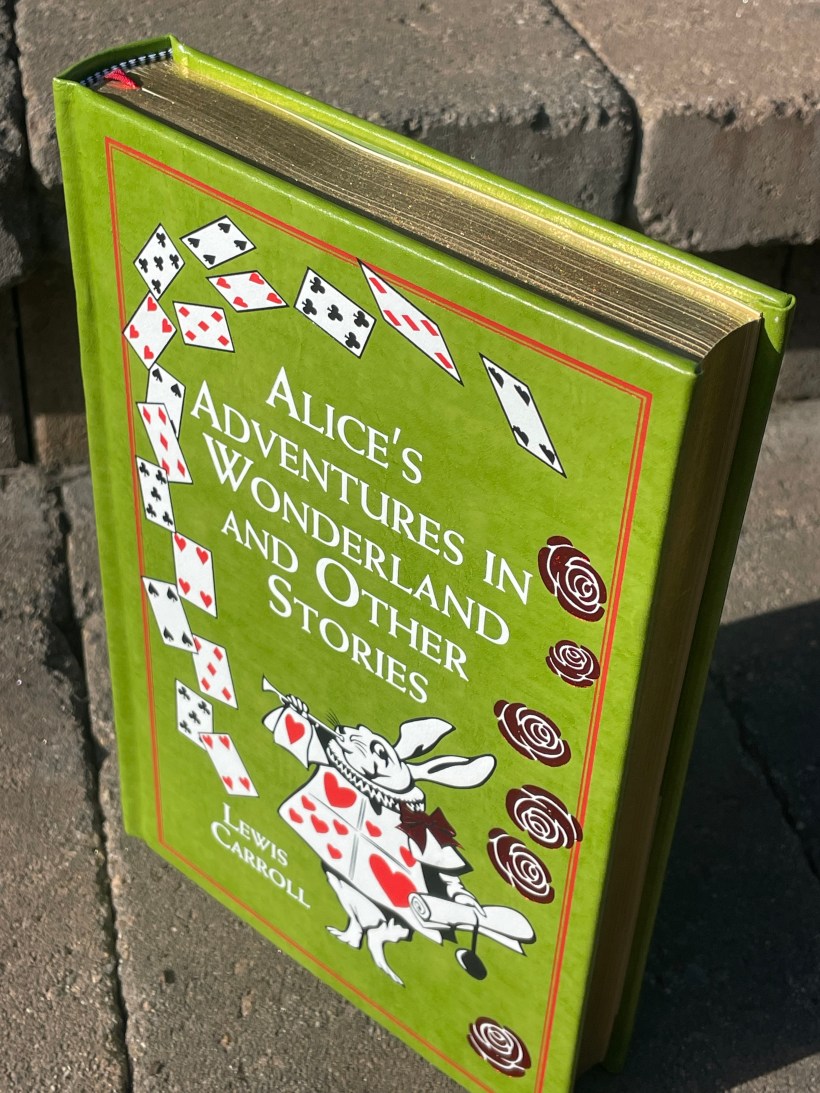
By Lewis Carroll
Discussion prompt by Matt Davis
“Whereas nonsense in literature prior to the Victorian era smacked of soft satire, during the 19th century it transformed into something more childish whose chief goal was to amuse.” G.K. Chesterton, The Defendant. In other words, a point of nonsensical literature during the Victorian era was to laugh! This is an interesting contrast given that the Victoria era is normally known for its proper manners and customs. Lewis Carroll in Alice in Wonderland and Through the Looking Glass take us on a wild and absurd adventure down the rabbit hole and into a world on the other side of a mirror. Is his purpose only to amuse?
The history and background of Lewis Carroll, also known as Charles Lutwidge Dodgson, is he was born in 1832 and died in 1898, just before his 66 birthday. Carroll was the third born and eldest son of eleven children. Carroll lived during the English Victorian era when nonsensical writing was “en vogue.” However, a couple of Carroll’s contemporary writers were Charles Dickens and Charlotte Bronte’, who did not write in the nonsensical genre that I am aware of. In addition to being an author, Carroll was a poet, mathematician, photographer, and Anglican Deacon. Experts believe that Carroll based the story of Alice off of the daughter of a close friend, Alice Liddell, even though he denies it.
To help us look at what Carroll was possibly intending in writing his stories, let’s look more closely at what was going on during his time. Queen Victoria was ruling England. She was known for working to privately influence government policy and ministerial appointments. But, publicly, she became a national icon who was identified with strict standards of personal morality. Victoria married her first cousin, Prince Albert, in 1840. Their nine children married into royal and noble families across the continent, earning Victoria the nickname “grandmother of Europe.” Overall, this was a prosperous time for English when children and nature were seen as inherently pure and uncorrupted, untouched by sin and evil. Charles Darwin published On the Origin of the Species in 1859, six years before Alice in Wonderland, which significantly altered this world view of children and nature.
Transitioning to Carroll’s first book, Alice’s Adventures in Wonderland, which was published in 1865, we see Alice falling into a dream as she lazily rests on a warm May day with her sister. After following the white rabbit down the hole, Alice meets many queer characters and has many odd experiences. One theme we see consistently throughout the book is Alice insulting and upsetting just about every character she comes in contact (other than the griffin and the turtle). From calling others stupid, to talking of how they may be eaten by a dog or a cat, or just putting others down, Alice can’t seem to do things right. Every poem or riddle she recites is all mixed up. She cannot remember her geography, multiplication, or historical facts or definitions. Regardless of Alice’s incompetences, she has a tremendous air of pride and arrogance. For a girl of seven years old, she seems to be wise in her own eyes and therefore seems to get into trouble at every turn.
Six months later, on a snowy wintery night, Alice lounges in the family room playing with her cats. She begins to wonder what it would be like to enter the world on the other side of the mirror. In Carroll’s sequel, Through the Looking Glass, published in 1871, Alice climbs through the mirror into a world that often seems to work backwards. Moving across a giant chess board, she interacts with life-sized chess pieces and other fun characters such as Tweedledum and Tweedledee, Humpty Dumpty, Haigha and Hatta, and a knat (to name a few). Alice seems to have matured tremendously as she spends more time listening and wondering. Interspersed with silly rhymes, poems, and riddles, we are entertained with “Amelia Bedelia” logic and dream-like transitions as characters come and go. At the end of the story, Alice finally makes it to the eighth square where she is queened and enjoys her royal party.
So is there meaning in Carroll’s writing? To quote Amanda Ryan, who wrote the introduction to Alice in Wonderland for Canon Press, “But does the absence of an obvious moral mean the story has no meaning? Here’s some sage advice from the King of Hearts, “Begin at the beginning and go on till you come to the end: then stop.”
Discussion Prompt by Tony Groesbeck
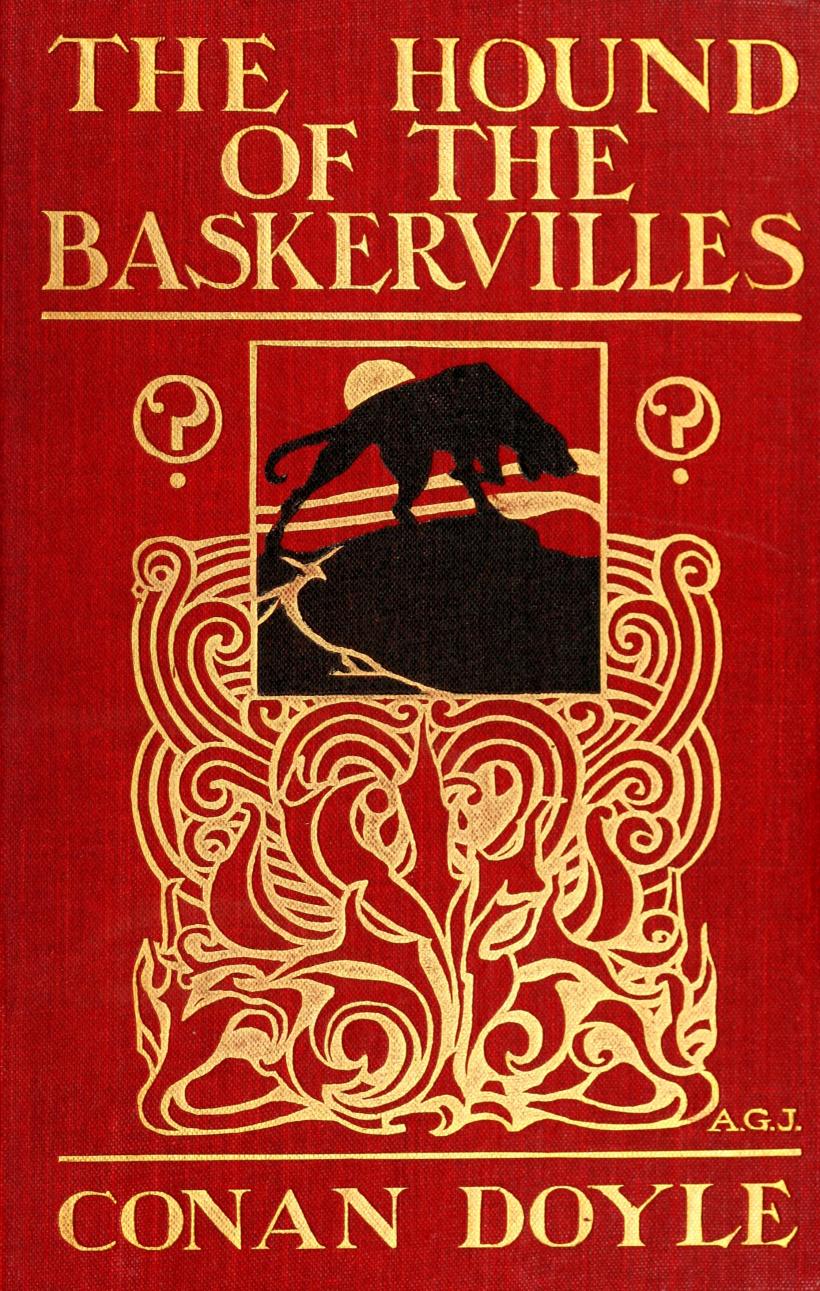
Sir Arthur Conan Doyle once complained about our friend, Sherlock, saying “If I had never touched Holmes, who has tended to obscure my higher work, my position in literature would at the present moment be a more commanding one.” Whether or not this is true, no one can say, but we do know that Sherlock Holmes, who appeared in four of Doyle’s 22 novels and 56 of his 204 short stories was and remains the most lucrative and recognizable figure in Doyle’s quiver of literary arrows.
What is it about Sherlock Holmes that has intrigued readers for so long? Perhaps Holmes and his methods give us a reassuring sense of security because we can expect that when the veils of insidious criminality and vile deception are drawn back, Holmes will calmly explain how something that seemed impossible, (or at least, incredible) is actually quite elementary to comprehend. This is certainly the case in “The Hound of the Baskervilles” wherein we (and our avatar, the dear Dr. Watson) are confronted with the legend of a spectral hound who has tormented the same family (the titular ‘Baskervilles’) for generations as a curse for the actions of a vicious member of the tribe.
The legend lays as follows: during the time of “The Great Rebellion”- a 1640’s English civil war of sorts (see your local history teacher for more info), a rogue of the first order named Hugo Baskerville liked a girl who was none too fond of him, and he pulled a “Gaston,” where he and a few of his fiendish cronies decided to kidnap the girl and imprison her, apparently hoping for a “Stockholm Syndrome” kind of courtship. The girl escaped, and Hugo, the fervent lover that he was, put his pack of hunting dogs on her trail to run her down. It was later reported that as Hugo galloped after her on his steed, a “hound of hell” chased Hugo in turn and was soon after seen tearing the throat out of the dastardly rapscallion. For the 250(ish) years since the event, the story of “The Hound of the Baskervilles” has haunted the nights and dreams of the Baskerville men.
It is a wonderfully gothic back story to intrigue the unremitting mind of Sherlock Holmes. To help readers get engaged with the mysterious tone of the tale, Doyle gives us Baskerville Hall; the imposing, dark, and foreboding ancestral home of the clan that seems to have been drawn from an Edgar Allen Poe story. What’s more, the location of the creepy old manse is the middle of a creepy old moor complete with bogs, mist, and some strange old paleolithic huts. The neighbors are weird, the butler and his wife are clearly involved in something shady as the woman is constantly weeping, and oh yeah- there’s an escaped homicidal convict rumored to be tramping about the area at night. Add a little erudite dismissal of the testimony of the “lesser peasants” and a doomed love affair that is a bit “near the knuckle,” and we are set up for a wonderful October read.
As we begin talking tonight, there are a few topics that might be fun to discuss.
 Ink & Stone