By Annie Dillard
Discussion Précis by Jeff Pratt
Saturday, 03/04/23
You know, when you hear the author say of herself that the book The Strange Lives of Familiar Insects (p. 170) is a book that she could not live without, that you are in for a different kind of literary adventure. I learned in the Afterword that Annie Dillard was 27 years old when she began writing The Pilgrim at Tinker Creek – for perspective, this is the age of my first born child, also a woman like Annie Dillard, with some powerful gifts with words. Yet Annie Dillard’s gift with words is true fecundity – like the title of ch 10 using this term – they have the ability to “produce many new ideas; an abundance of new growth, or fertility.” She employs words to do OH SO MUCH more than communicate her profound power of observation and contemplation of nature, but also envelop complexity (at times to the degree of befuddlement, at least for me) from her extensive reading and research. In one moment I was moved to tears by the shear intense beauty of her words, and other moments tattered by being “forced to drink too much from a fire hose” or whiplashed because when I thought I was being directed to consider the implausibility of the force and growth-rate of plant roots, for example, I am the next moment trying to process biblical illusion or non-Platonic philosophy. Her writing is extraordinary, and it would be simply remiss to not hear a significant portion read aloud. I have chosen this excerpt from her chapter titled “The Present” :
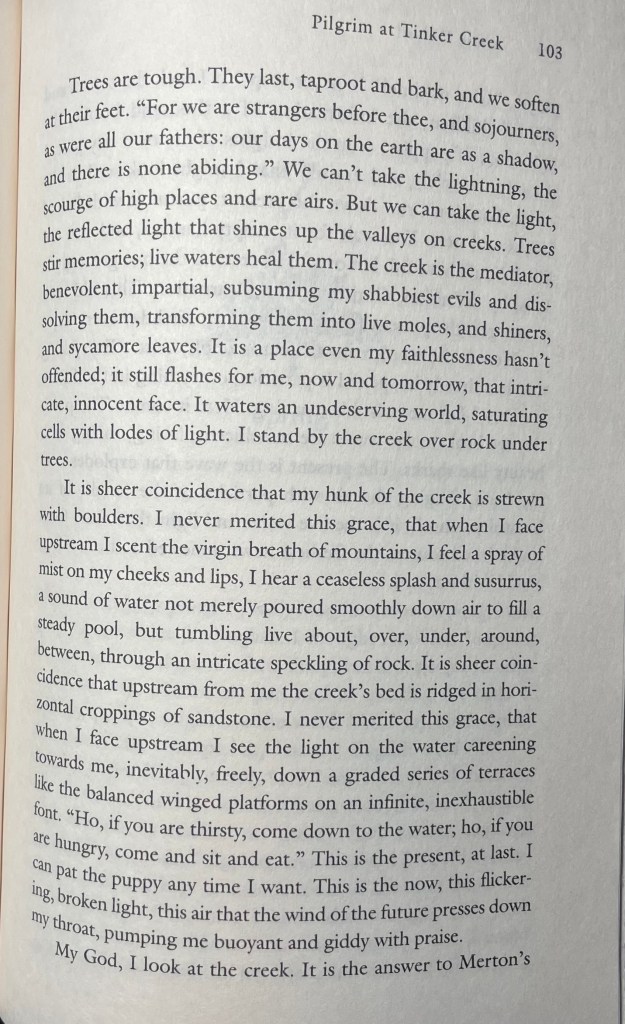

“You don’t run down the present…you wait for it, empty handed and you are filled.” This is how you “pilgrim.” And, as far as we know, humans are the only creatures in all creation who have the ability to “pilgrim” – to observe nature, conduct a meta-analysis of our observing, to “wait” and consider what it means to be filled. Near the end of her book, Dillard writes, “Come on, I say to the creek, surprise me; and it does, with each new drop. Beauty is real. I would never deny it; the appalling thing is that I forget it.” (p. 271). Gents, as we lift a glass and dive into this Pulitzer prize work, I ask us to consider, in what ways have you tried to “chase down the present” and forgotten beauty? Cheers!
Audiobook – click to open Chapter 1 “Heaven and Earth in Jest” read by J. Pratt
 Ink & Stone